

Careers
We are who we are because of our employees!
At Southeast Kansas Mental Health Center, we believe meaningful work starts with meaningful connection. Every day, our team helps individuals, families, and communities across Southeast Kansas access compassionate behavioral health care and support. Behind every life impacted is a dedicated employee whose passion, skills, and commitment make a difference.
We are proud to foster a workplace built on collaboration, growth, and purpose. Whether you work directly with clients or support our mission behind the scenes, your work matters here. If you are looking for a career where you feel valued, supported, and part of something bigger, we invite you to join our team.
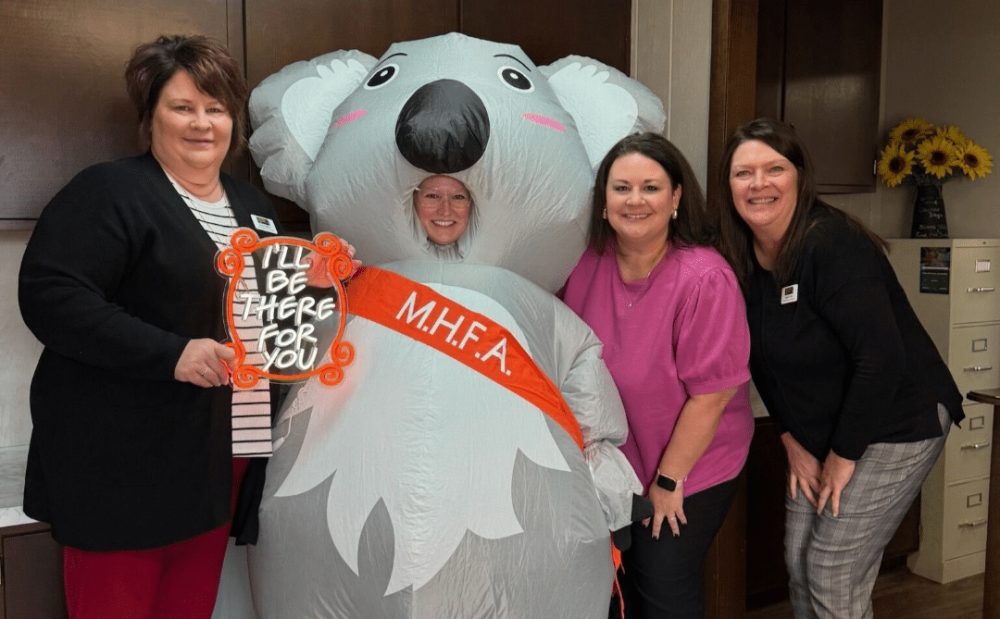
I enjoy working at Southeast Kansas Mental Health Center for many reasons, but two of the most important factors are my coworkers and the support we offer each other. As a therapist, I am excited when those I work with have that moment of clarity and self-determination.
Debora J. Higginbotham, LMSW, LMAC, Outpatient Therapist
Started with SEKMHC in 2016
Benefits
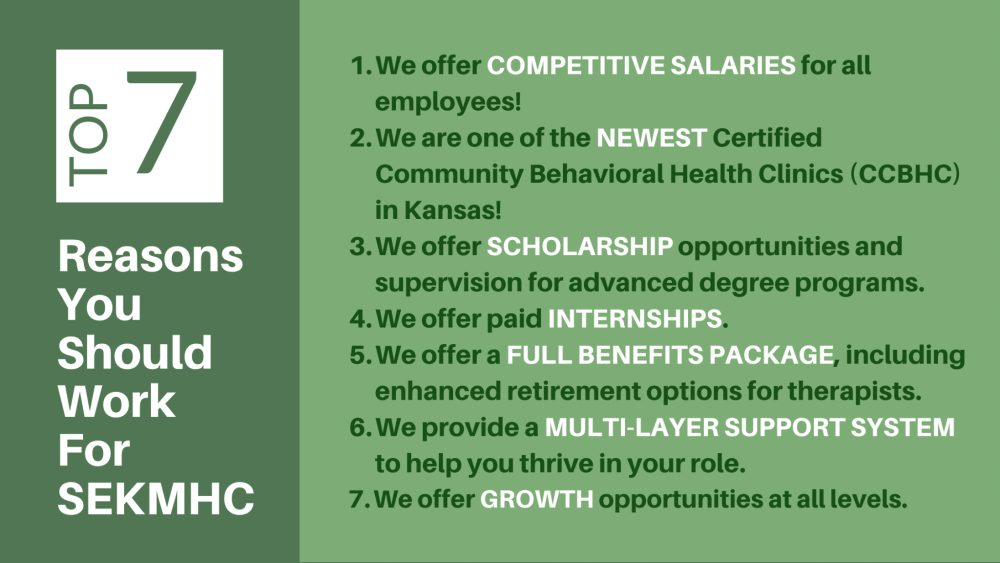
SEKMHC provides a full benefits package to our employees.






Career Opportunities at SEKMHC
Full-Time- 1 Position Open
(Covering Allen County)
QUALIFICATIONS:
Must have a BA/BS degree or four years of equivalent education and/or experience working in the human services field. Must pass KBI, DCF child & adult abuse check, motor vehicle screen, and background checks. If the position requires the use of a personal vehicle for work purposes, the employee must have reliable, insured transportation that is properly registered and compliant with all applicable state and local
requirements.
KNOWLEDGE, SKILLS, AND ABILITIES REQUIRED:
1. Strong communication, problem-solving skills, and organizational skills.
2. Ability to work collaboratively in a team environment.
3. Ability to work independently in the community.
4. Proficient with computers and word processing.
DUTIES AND RESPONSIBILITIES:
COMMUNITY PSYCHIATRIC SUPPORTIVE TREATMENT (CPST):
1. Provide face-to-face, community-based interventions with patients that are solution-focused and goal directed as determined by their individualized treatment plan.
2. Assist the patient in identifying strategies or treatment options.
3. Provide individual supportive counseling, solution-focused interventions, emotional and behavioral management, and problem behavior analysis with the patient.
4. Assist the patient in addressing functional deficits associated with the Patient's mental illness by developing goals and objectives that identify and utilize their strengths and needs, resources, and natural supports.
5. Assist patients in remaining in their natural community locations by assisting them in identifying and effectively responding to or avoiding identified precursors or triggers. Additionally, help identify potential psychiatric or personal crises and develop a crisis management plan to restore stability and functioning.
TARGETED CASE MANAGEMENT (TCM) The goal is to enhance the patient's independent functioning by assisting them in obtaining access to needed medical, social, educational, and other services in accordance with their individualized treatment plan. Supports include:
1. Treatment Planning:
i. Facilitating or coordinating the team treatment planning process to include patients, treating therapists, families, and other natural supports.
ii. Assist in developing strengths-based goals and objectives, documenting the treatment plan, monitoring its effectiveness, and making changes when needed.
iii. Monitor treatment plan due dates, advise patient and therapist of due date, and schedule an appointment for the patient to meet with the therapist to update the plan prior to the expiration date.
2. Collateral Contacts: Coordinate the patient's treatment needs via phone and written correspondence, as well as face-to-face contacts with other social service agencies, housing and employment resources, and medical services.
3. Access to Supports: Assist the patient in obtaining access to needed medical, social, educational, and other services. Also assist with applications for benefits and arrange transportation to needed services.
OTHER SERVICES:
Provide and/or coordinate these additional services as determined by the patient's individualized treatment plan:
1. Attendant Care
2. Psychosocial Rehabilitation Services
3. Crisis Intervention or Stabilization
DOCUMENTATION: Document services in accordance with state, federal, and organizational regulations, policies, and procedures.
1. Must document all direct services and coordination of services in the patient's electronic health record (EHR).
2. Document services concurrently (i.e., simultaneous to services) and submit to EHR in accordance to policies, procedures, and time requirements.
3. Complete and submit month-end Patient Status Reports.
REQUIRED TRAININGS: Examples include:
1. Community Psychiatric Support and Treatment (CPST):
i. University of Kansas Basic Case Management Training (2 days) within 6 months after date hired.
ii. University of Kansas Advanced Case Management Training (1 per year). Attend within the first year of employment, and one training is required each year thereafter.
2. Adult Attendant Care Online Training (Track B): Complete prior to delivery of service.
3. Targeted Case Management Online Training: Complete within 60 days of hire and prior to providing service.
4. Crisis Intervention (CI) online training: Complete prior to delivery of service.
OTHER IN-HOUSE OR ONLINE TRAININGS: As determined by your supervisor. Core trainings are due within the first year, and employees are advised by their supervisors when trainings are due.
DIRECT SERVICE EXPECTATIONS: This position has a minimum service credit expectation and will be provided by your supervisor.
TRANSPORTATION AND DELIVERY: For work-related travel, employees must operate company or personal vehicles responsibly, in accordance with all traffic laws, regulations, and organizational safety policies.
WORKING CONDITIONS AND REQUIREMENTS:
1. Regular and punctual attendance is required and is an essential function of this position.
2. This position requires the ability to operate a vehicle as part of routine job functions.
3. This position requires the ability to use a computer and software as part of routine job functions.
4. Employees are expected to perform duties at the designated work location stated in the offer letter unless otherwise noted by your supervisor.
5. Attendance at in-person meetings and training sessions is required, even for remote or hybrid roles, as necessary, unless otherwise noted by your supervisor.
6. Occasional overtime may be required depending on operational needs. Overtime will be compensated in accordance with applicable wage and hour laws.
7. This position requires the ability to lift and carry up to 25 lbs as part of routine job functions.
8. Perform other duties as assigned by your Supervisor or the Chief Executive Officer.
Part-Time- Multiple Positions Available
(Allen, Anderson, Bourbon, Linn Counties)
QUALIFICATIONS:
Must be at least 18 years old and have a high school diploma or equivalent. Must pass KBI, DCF child & adult abuse check, motor vehicle screen, and background checks. If the position requires the use of a personal vehicle for work purposes, the employee must have reliable, insured transportation that is properly registered and compliant with all applicable state and local requirements.
KNOWLEDGE, SKILLS, AND ABILITIES REQUIRED:
1. Strong communication, problem-solving skills, and organizational skills.
2. Ability to work collaboratively in a team environment.
3. Ability to work independently in the community.
4. Proficient with computers and word processing.
DUTIES AND RESPONSIBILITIES: Our SEKA Children’s Aide program provides support to children within a collaborative team setting. This role requires the ability to transport patients using your personal vehicle, as needed and at your supervisor's direction.
1. Turn in all staff daily service logs and roll call sheets directly to office staff via packet, email, or fax as appropriate.
2. Service log and roll call sheets to ensure they are correct and match.
3. Check service logs and roll call sheets to ensure they are correct and match.
4. Review units and times on the logs to ensure they are correct and match.
5. Review and lock all staff progress notes in a timely manner as directed by policy.
6. Ensure the narrative part of the note meets the quality standard.
7. Ensure that appropriate reference numbers are included for each day, confirmation code, units, time of service, and location are added as applicable.
8. Ensure that on each progress note, the assigned therapist's name for each child is included on the note to be written in the top right-hand corner.
9. Meet with any staff who need additional training.
10. Assist with weekly shopping.
11. Share responsibility in all preparation required for group each day.
TRANSPORTATION AND DELIVERY: For work-related travel, employees must operate company or personal vehicles responsibly, in accordance with all traffic laws, regulations, and organizational safety policies.
WORKING CONDITIONS AND REQUIREMENTS:
1. Regular and punctual attendance is required and is an essential function of this position.
2. This position requires the ability to operate a vehicle as part of routine job functions.
3. This position requires the ability to use a computer and software as part of routine job functions.
4. Employees are expected to perform duties at the designated work location stated in the offer letter unless otherwise noted by your supervisor.
5. Attendance at in-person meetings and training sessions is required, even for remote or hybrid roles, as necessary, unless otherwise noted by your supervisor.
6. Occasional overtime may be required depending on operational needs. Overtime will be compensated in accordance with applicable wage and hour laws.
7. This position requires the ability to lift and carry up to 25 lbs as part of routine job functions.
8. Perform other duties as assigned by your Supervisor or the Chief Executive Officer.
Full Time In-Office- 1 Position Available
(QMHP preferred)
(Covering Iola, Chanute & Fort Scott)
QUALIFICATIONS:
BA/BS degree or five years of equivalent education and/or experience working with mental health & substance use field. QMHP preferred. Must pass KBI, DCF child & adult abuse check, motor vehicle screen, and background checks. If the position requires the use of a personal vehicle for work purposes, the employee must have reliable, insured transportation that is properly registered and compliant with all applicable state and local requirements.
KNOWLEDGE, SKILLS, AND ABILITIES REQUIRED:
1. Strong communication, problem-solving skills, and organizational skills.
2. Ability to work collaboratively in a team environment.
3. Ability to work independently in the community.
4. Proficient with computers and word processing.
DUTIES AND RESPONSIBILITIES: The ACT Team Lead will also have a small case management case load with very high needs and difficult-to-engage patients.
STAFF TEAM LEAD:
1. Oversee staff, documentation, finances, treatment, program planning, and goal setting for assigned team.
2. Provide Evidence-Based Practices training to newly hired staff and provide information and updated training to current team members.
3. Provide consultation to teams who have questions regarding patient issues, community resources, etc., while ensuring the treatment provided to patients is in accordance with SEKMHC policies and procedures.
4. Review goals and targets with the Director of Adult Services to ensure that direct service goals are being met and develop plans to help the team achieve them.
TARGETED CASE MANAGEMENT (TCM) The goal is to enhance the patient's independent functioning by assisting them in obtaining access to needed medical, educational, and other services in accordance with their individualized treatment plan. Supports include:
1. Treatment Planning:
i. Facilitating or coordinating the team treatment planning process to include patients, treating therapists, families, and other supports.
ii. Assist in developing strengths-based goals and objectives, documenting the treatment plan, monitoring its effectiveness, and making necessary changes.
iii. Monitor treatment plan due dates, advise the patient and therapist of the due date, and schedule an appointment for the patient to meet with the therapist to update the plan prior to the expiration date.
2. Collateral Contacts: Coordinate the patient's treatment needs via phone and written correspondence, as well as face-to-face contacts with other social service agencies, housing and employment resources, and medical services.
3. Access to Supports: Assist the Patient in obtaining access to needed medical, educational, and other services. Also, assist with benefits applications and arrange transportation to needed services.
OTHER SERVICES: Provide and/or coordinate these additional services as determined by the patient's individualized treatment plan:
1. Attendant Care.
2. Psychosocial Rehabilitation Services.
3. Crisis Intervention or Stabilization.
DOCUMENTATION: Document services in accordance with state, federal, and organizational regulations, policies, and procedures.
1. All direct services and coordination of services must be documented in the patient's electronic health record (EHR).
2. Document services concurrently (i.e., simultaneously to services) and submit to EHR in accordance with policies, procedures, and time requirements.
3. Complete and submit the month-end patient Status Reports.
REQUIRED TRAININGS: Examples include:
1. Community Psychiatric Support and Treatment (CPST):
i. University of Kansas Basic Case Management Training (2 days) within 6 months after date hired.
ii. University of Kansas Advanced Case Management Training (1 per year). Attend within the first year of employment.
2. Adult Attendant Care Online Training (Track B): Complete prior to delivery of service.
3. Targeted Case Management Online Training: Complete within 60 days of hire and prior to attending ICE training.
4. Crisis Intervention (CI) online training: Complete prior to delivery of service.
OTHER IN-HOUSE OR ONLINE TRAININGS: As determined by your supervisor. Core training is due within the first year; the supervisor advises the employee when training is due.
DIRECT SERVICE EXPECTATIONS: This position has a minimum service credit expectation and will be provided by your supervisor.
TRANSPORTATION AND DELIVERY: For work-related travel, employees must operate company or personal vehicles responsibly, in accordance with all traffic laws, regulations, and organizational safety policies.
WORKING CONDITIONS AND REQUIREMENTS:
1. Regular and punctual attendance is required and is an essential function of this position.
2. This position requires the ability to operate a vehicle as part of routine job functions.
3. This position requires the ability to use a computer and software as part of routine job functions.
4. Employees are expected to perform duties at the designated work location stated in the offer letter unless otherwise noted by your supervisor.
5. Attendance at in-person meetings and training sessions is required, even for remote or hybrid roles, as necessary, unless otherwise noted by your supervisor.
6. Occasional overtime may be required depending on operational needs. Overtime will be compensated in accordance with applicable wage and hour laws.
7. This position requires the ability to lift and carry up to 25 lbs as part of routine job functions.
8. Perform other duties as assigned by your Supervisoror the Chief Executive Officer.
Full-Time- 1 Position Available
(Covering Allen & Neosho County)
QUALIFICATIONS:
BA/BS degree or four years of equivalent education and/or experience working in the human services field. Must pass KBI, DCF child & adult abuse check, motor vehicle screen, and background checks. If the position requires the use of a personal vehicle for work purposes, the employee must have reliable, insured transportation that is properly registered and compliant with all applicable state and local requirements.
KNOWLEDGE, SKILLS, AND ABILITIES REQUIRED:
1. Strong communication, problem-solving skills, and organizational skills.
2. Ability to work collaboratively in a team environment.
3. Ability to work independently in the community.
4. Proficient with computers and word processing.
DUTIES AND RESPONSIBILITIES:
COMMUNITY PSYCHIATRIC SUPPORTIVE TREATMENT (CPST):
1. Provide face-to-face, community-based interventions with patients that are solution-focused and goal directed as determined by their individualized treatment plan.
2. Assist the patient in identifying strategies or treatment options.
3. Provide solution-focused interventions, emotional and behavioral management, and problem behavior analysis with the patient.
4. Assist the patient in addressing functional deficits by developing goals and objectives that identify and utilize their strengths and needs, resources, and supports.
5. Assist patients in remaining in their community locations by identifying and effectively responding to or avoiding identified precursors or triggers. Additionally, help identify potential psychiatric or personal crises and develop a crisis management plan to restore stability and functioning.
TARGETED CASE MANAGEMENT (TCM) The goal is to enhance the patient's independent functioning by assisting them in obtaining access to needed medical, educational, and other services in accordance with their individualized treatment plan. Supports include:
1. Treatment Planning:
i. Facilitating or coordinating the team treatment planning process to include patients,
treating therapists, families, and other supports.
ii. Assist in developing strengths-based goals and objectives, documenting the treatment plan, monitoring its effectiveness, and making necessary changes.
iii. Monitor treatment plan due dates, advise the patient and therapist of the due date, and schedule an appointment for the patient to meet with the therapist to update the plan prior to the expiration date.
2. Collateral Contacts: Coordinate the patient's treatment needs via phone and written
correspondence, as well as face-to-face contacts with other social service agencies, housing and employment resources, and medical services.
3. Access to Supports: Assist the Patient in obtaining access to needed medical, educational, and otherservices. Also, assist with benefits applications and arrange transportation to needed services.
4. Coordination for Youth: Coordinate services and supports identified in the patient's wraparound or treatment plan. This must include coordination with family, significant others, and other systems of care, such as education, juvenile justice, and child welfare.
WRAPAROUND FACILITATION: Form the wraparound team to produce a community-based,individualized Plan of Care. Responsibilities include:
1. Work with family to identify who should be involved in the wraparound team.
2. Guide the Plan of Care process and ensure waiver rules are followed.
3. Reassemble the team every 90 days and when Plan of Care reviews are needed.
4. Build collaboration and ongoing coordination among all team members and supports.
5. Must document all coordination in the youth's medical record.
OTHER SERVICES: Provide and/or coordinate these additional services as determined by the patient's individualized treatment plan:
1. Attendant Care.
2. Psychosocial Rehabilitation Services.
3. Independent Living/Skills Building.
4. Parent Support and Training.
5. Short-Term Respite Care (Provided by SKE Respite).
6. Crisis Intervention or Stabilization.
DOCUMENTATION: Document services in accordance with state, federal, and organizational regulations, policies, and procedures.
1. All direct services and coordination of services must be documented in the patient's electronic health record (EHR).
2. Document services concurrently (i.e., simultaneously to services) and submit to EHR in accordance with policies, procedures, and time requirements.
3. Complete and submit the month-end Patient Status Reports.
REQUIRED TRAININGS:
MEDICAID STATE PLAN NON-WAIVER SERVICES (see www.kidstraining.org) INCLUDE:
1. Community Psychiatric Support and Treatment (CPST):
i. CPST online: Complete within 60 days of hire.
ii. Interactive Community Event (ICE): Attend within 6 months of hire.
2. Psychosocial Rehabilitation Online Training (Track B): Complete prior to delivery of service.
3. Targeted Case Management Online Training: Complete within 60 days of hire and prior to attending ICE training.
4. Crisis Intervention (CI) online training: Complete prior to delivery of service.
5. Nationally recognized CI training (e.g., Mandt training, provided in-house).
OTHER IN-HOUSE OR ONLINE TRAININGS: As determined by your supervisor. Core training is due within the first year; the supervisor advises the employee when training is due.
HCBS MEDICAIRD WAIVER SERVICES: (see www.kidstraining.org) as indicated by your patient’s treatment needs or required by your supervisor. Examples include:
1. Attendant Care (AC): Prior to delivery of service
2. Independent Living/Skills Building: Prior to delivery of service
3. Wrap-Around Facilitation (WAF): Prior to delivery of service
4. Parent Support and Training (PST):Within 60 days of hire or after
DIRECT SERVICE EXPECTATIONS: This position has a minimum service credit expectation and will be provided by your supervisor.
TRANSPORTATION AND DELIVERY: For work-related travel, employees must operate company or personal vehicles responsibly, in accordance with all traffic laws, regulations, and organizational safety policies.
WORKING CONDITIONS AND REQUIREMENTS:
1. Regular and punctual attendance is required and is an essential function of this position.
2. This position requires the ability to operate a vehicle as part of routine job functions.
3. This position requires the ability to use a computer and software as part of routine job functions.
4. Employees are expected to perform duties at the designated work location stated in the offer letter unless otherwise noted by your supervisor.
5. Attendance at in-person meetings and training sessions is required, even for remote or hybrid roles, as necessary, unless otherwise noted by your supervisor.
6. Occasional overtime may be required depending on operational needs. Overtime will be compensated in accordance with applicable wage and hour laws
7. This position requires the ability to lift and carry up to 25 lbs as part of routine job functions.
8. Perform other duties as assigned by your Supervisor or the Chief Executive Officer.
Full-Time
(Chanute)
QUALIFICATIONS:
BA/BS degree or four years of equivalent education and/or experience working in the human services field. Must pass KBI, DCF child & adult abuse check, motor vehicle screen, and background checks. If the position requires the use of a personal vehicle for work purposes, the employee must have reliable, insured transportation that is properly registered and compliant with all applicable state and local requirements.
KNOWLEDGE, SKILLS, AND ABILITIES REQUIRED:
1. Strong communication, problem-solving skills, and organizational skills.
2. Ability to work collaboratively in a team environment.
3. Ability to work independently in the community.
4. Proficient with computers and word processing.
DUTIES AND RESPONSIBILITIES:
COMMUNITY PSYCHIATRIC SUPPORTIVE TREATMENT (CPST):
1. Provide face-to-face, community-based interventions with patients that are solution-focused and goal directed as determined by their individualized treatment plan.
2. Assist the patient in identifying strategies or treatment options.
3. Provide solution-focused interventions, emotional and behavioral management, and problem behavior analysis with the patient.
4. Assist the patient in addressing functional deficits by developing goals and objectives that identify and utilize their strengths and needs, resources, and supports.
5. Assist patients in remaining in their community locations by identifying and effectively responding to or avoiding identified precursors or triggers. Additionally, help identify potential psychiatric or personal crises and develop a crisis management plan to restore stability and functioning.
TARGETED CASE MANAGEMENT (TCM) The goal is to enhance the patient's independent functioning by assisting them in obtaining access to needed medical, educational, and other services in accordance with their individualized treatment plan. Supports include:
1. Treatment Planning:
i. Facilitating or coordinating the team treatment planning process to include patients,
treating therapists, families, and other supports.
ii. Assist in developing strengths-based goals and objectives, documenting the treatment plan, monitoring its effectiveness, and making necessary changes.
iii. Monitor treatment plan due dates, advise the patient and therapist of the due date, and schedule an appointment for the patient to meet with the therapist to update the plan prior to the expiration date.
2. Collateral Contacts: Coordinate the patient's treatment needs via phone and written
correspondence, as well as face-to-face contacts with other social service agencies, housing and employment resources, and medical services.
3. Access to Supports: Assist the Patient in obtaining access to needed medical, educational, and otherservices. Also, assist with benefits applications and arrange transportation to needed services.
4. Coordination for Youth: Coordinate services and supports identified in the patient's wraparound or treatment plan. This must include coordination with family, significant others, and other systems of care, such as education, juvenile justice, and child welfare.
WRAPAROUND FACILITATION: Form the wraparound team to produce a community-based,individualized Plan of Care. Responsibilities include:
1. Work with family to identify who should be involved in the wraparound team.
2. Guide the Plan of Care process and ensure waiver rules are followed.
3. Reassemble the team every 90 days and when Plan of Care reviews are needed.
4. Build collaboration and ongoing coordination among all team members and supports.
5. Must document all coordination in the youth's medical record.
OTHER SERVICES: Provide and/or coordinate these additional services as determined by the patient's individualized treatment plan:
1. Attendant Care.
2. Psychosocial Rehabilitation Services.
3. Independent Living/Skills Building.
4. Parent Support and Training.
5. Short-Term Respite Care (Provided by SKE Respite).
6. Crisis Intervention or Stabilization.
DOCUMENTATION: Document services in accordance with state, federal, and organizational regulations, policies, and procedures.
1. All direct services and coordination of services must be documented in the patient's electronic health record (EHR).
2. Document services concurrently (i.e., simultaneously to services) and submit to EHR in accordance with policies, procedures, and time requirements.
3. Complete and submit the month-end Patient Status Reports.
REQUIRED TRAININGS:
MEDICAID STATE PLAN NON-WAIVER SERVICES (see www.kidstraining.org) INCLUDE:
1. Community Psychiatric Support and Treatment (CPST):
i. CPST online: Complete within 60 days of hire.
ii. Interactive Community Event (ICE): Attend within 6 months of hire.
2. Psychosocial Rehabilitation Online Training (Track B): Complete prior to delivery of service.
3. Targeted Case Management Online Training: Complete within 60 days of hire and prior to attending ICE training.
4. Crisis Intervention (CI) online training: Complete prior to delivery of service.
5. Nationally recognized CI training (e.g., Mandt training, provided in-house).
OTHER IN-HOUSE OR ONLINE TRAININGS: As determined by your supervisor. Core training is due within the first year; the supervisor advises the employee when training is due.
HCBS MEDICAIRD WAIVER SERVICES: (see www.kidstraining.org) as indicated by your patient’s treatment needs or required by your supervisor. Examples include:
1. Attendant Care (AC): Prior to delivery of service
2. Independent Living/Skills Building: Prior to delivery of service
3. Wrap-Around Facilitation (WAF): Prior to delivery of service
4. Parent Support and Training (PST):Within 60 days of hire or after
DIRECT SERVICE EXPECTATIONS: This position has a minimum service credit expectation and will be provided by your supervisor.
TRANSPORTATION AND DELIVERY: For work-related travel, employees must operate company or personal vehicles responsibly, in accordance with all traffic laws, regulations, and organizational safety policies.
WORKING CONDITIONS AND REQUIREMENTS:
1. Regular and punctual attendance is required and is an essential function of this position.
2. This position requires the ability to operate a vehicle as part of routine job functions.
3. This position requires the ability to use a computer and software as part of routine job functions.
4. Employees are expected to perform duties at the designated work location stated in the offer letter unless otherwise noted by your supervisor.
5. Attendance at in-person meetings and training sessions is required, even for remote or hybrid roles, as necessary, unless otherwise noted by your supervisor.
6. Occasional overtime may be required depending on operational needs. Overtime will be compensated in accordance with applicable wage and hour laws
7. This position requires the ability to lift and carry up to 25 lbs as part of routine job functions.
8. Perform other duties as assigned by your Supervisor or the Chief Executive Officer.
Full-Time
(Covering Linn County)
QUALIFICATIONS:
BA/BS degree or four years of equivalent education and/or experience working in the human services field. Must pass KBI, DCF child & adult abuse check, motor vehicle screen, and background checks. If the position requires the use of a personal vehicle for work purposes, the employee must have reliable, insured transportation that is properly registered and compliant with all applicable state and local requirements.
KNOWLEDGE, SKILLS, AND ABILITIES REQUIRED:
1. Strong communication, problem-solving skills, and organizational skills.
2. Ability to work collaboratively in a team environment.
3. Ability to work independently in the community.
4. Proficient with computers and word processing.
DUTIES AND RESPONSIBILITIES:
COMMUNITY PSYCHIATRIC SUPPORTIVE TREATMENT (CPST):
1. Provide face-to-face, community-based interventions with patients that are solution-focused and goal directed as determined by their individualized treatment plan.
2. Assist the patient in identifying strategies or treatment options.
3. Provide solution-focused interventions, emotional and behavioral management, and problem behavior analysis with the patient.
4. Assist the patient in addressing functional deficits by developing goals and objectives that identify and utilize their strengths and needs, resources, and supports.
5. Assist patients in remaining in their community locations by identifying and effectively responding to or avoiding identified precursors or triggers. Additionally, help identify potential psychiatric or personal crises and develop a crisis management plan to restore stability and functioning.
TARGETED CASE MANAGEMENT (TCM) The goal is to enhance the patient's independent functioning by assisting them in obtaining access to needed medical, educational, and other services in accordance with their individualized treatment plan. Supports include:
1. Treatment Planning:
i. Facilitating or coordinating the team treatment planning process to include patients,
treating therapists, families, and other supports.
ii. Assist in developing strengths-based goals and objectives, documenting the treatment plan, monitoring its effectiveness, and making necessary changes.
iii. Monitor treatment plan due dates, advise the patient and therapist of the due date, and schedule an appointment for the patient to meet with the therapist to update the plan prior to the expiration date.
2. Collateral Contacts: Coordinate the patient's treatment needs via phone and written
correspondence, as well as face-to-face contacts with other social service agencies, housing and employment resources, and medical services.
3. Access to Supports: Assist the Patient in obtaining access to needed medical, educational, and otherservices. Also, assist with benefits applications and arrange transportation to needed services.
4. Coordination for Youth: Coordinate services and supports identified in the patient's wraparound or treatment plan. This must include coordination with family, significant others, and other systems of care, such as education, juvenile justice, and child welfare.
WRAPAROUND FACILITATION: Form the wraparound team to produce a community-based,individualized Plan of Care. Responsibilities include:
1. Work with family to identify who should be involved in the wraparound team.
2. Guide the Plan of Care process and ensure waiver rules are followed.
3. Reassemble the team every 90 days and when Plan of Care reviews are needed.
4. Build collaboration and ongoing coordination among all team members and supports.
5. Must document all coordination in the youth's medical record.
OTHER SERVICES: Provide and/or coordinate these additional services as determined by the patient's individualized treatment plan:
1. Attendant Care.
2. Psychosocial Rehabilitation Services.
3. Independent Living/Skills Building.
4. Parent Support and Training.
5. Short-Term Respite Care (Provided by SKE Respite).
6. Crisis Intervention or Stabilization.
DOCUMENTATION: Document services in accordance with state, federal, and organizational regulations, policies, and procedures.
1. All direct services and coordination of services must be documented in the patient's electronic health record (EHR).
2. Document services concurrently (i.e., simultaneously to services) and submit to EHR in accordance with policies, procedures, and time requirements.
3. Complete and submit the month-end Patient Status Reports.
REQUIRED TRAININGS:
MEDICAID STATE PLAN NON-WAIVER SERVICES (see www.kidstraining.org) INCLUDE:
1. Community Psychiatric Support and Treatment (CPST):
i. CPST online: Complete within 60 days of hire.
ii. Interactive Community Event (ICE): Attend within 6 months of hire.
2. Psychosocial Rehabilitation Online Training (Track B): Complete prior to delivery of service.
3. Targeted Case Management Online Training: Complete within 60 days of hire and prior to attending ICE training.
4. Crisis Intervention (CI) online training: Complete prior to delivery of service.
5. Nationally recognized CI training (e.g., Mandt training, provided in-house).
OTHER IN-HOUSE OR ONLINE TRAININGS: As determined by your supervisor. Core training is due within the first year; the supervisor advises the employee when training is due.
HCBS MEDICAIRD WAIVER SERVICES: (see www.kidstraining.org) as indicated by your patient’s treatment needs or required by your supervisor. Examples include:
1. Attendant Care (AC): Prior to delivery of service
2. Independent Living/Skills Building: Prior to delivery of service
3. Wrap-Around Facilitation (WAF): Prior to delivery of service
4. Parent Support and Training (PST):Within 60 days of hire or after
DIRECT SERVICE EXPECTATIONS: This position has a minimum service credit expectation and will be provided by your supervisor.
TRANSPORTATION AND DELIVERY: For work-related travel, employees must operate company or personal vehicles responsibly, in accordance with all traffic laws, regulations, and organizational safety policies.
WORKING CONDITIONS AND REQUIREMENTS:
1. Regular and punctual attendance is required and is an essential function of this position.
2. This position requires the ability to operate a vehicle as part of routine job functions.
3. This position requires the ability to use a computer and software as part of routine job functions.
4. Employees are expected to perform duties at the designated work location stated in the offer letter unless otherwise noted by your supervisor.
5. Attendance at in-person meetings and training sessions is required, even for remote or hybrid roles, as necessary, unless otherwise noted by your supervisor.
6. Occasional overtime may be required depending on operational needs. Overtime will be compensated in accordance with applicable wage and hour laws
7. This position requires the ability to lift and carry up to 25 lbs as part of routine job functions.
8. Perform other duties as assigned by your Supervisor or the Chief Executive Officer.
PRN
QUALIFICATIONS:
Must be at least 18 years old and have a high school diploma or equivalent. Additional education in behavioral health, psychology, human services, or a related field is preferred. Must pass KBI, DCF child & adult abuse check, motor vehicle screen, and background checks. If the position requires the use of a personal vehicle for work purposes, the employee must have reliable, insured transportation that is properly registered and compliant with all applicable state and local requirements.
KNOWLEDGE, SKILLS, AND ABILITIES REQUIRED:
1. Strong communication, problem-solving skills, and organizational skills.
2. Ability to work collaboratively in a team environment.
3. Ability to work independently in the community.
4. Proficient with computers and word processing.
5. Frequently drive for extended periods.
6. Ability to assist clients entering and exiting vehicles.
7. Ability to respond appropriately during behavioral health emergencies.
DUTIES AND RESPONSIBILITIES:
1. Provide transportation and support for clients traveling to appointments, treatment centers, inpatient hospitals, and other necessary services.
2. Remain with clients during transportation and, when appropriate, during appointments or admissions to provide support and ensure continuity of care.
3. Observe and report changes in client behavior, mood, or functioning to the appropriate clinical staff.
4. Assist clients with admissions, discharges, paperwork, and coordination of services as directed.
5. Maintain ongoing communication with the Crisis Team regarding client status, transportation delays, safety concerns, and service needs.
6. Ensure client confidentiality in accordance with HIPAA and agency policies.
7. Complete accurate and timely documentation of transportation services, client contacts, mileage, incidents, and other required records.
8. Follow all agency safety procedures, infection control guidelines, and emergency response protocols.
9. Maintain knowledge of community behavioral health resources and referral options.
TRANSPORTATION AND DELIVERY: For work-related travel, employees must operate company or personal vehicles responsibly, in accordance with all traffic laws, regulations, and organizational safety policies.
WORKING CONDITIONS AND REQUIREMENTS:
1. Regular and punctual attendance is required and is an essential function of this position.
2. This position requires the ability to operate a vehicle as part of routine job functions.
3. This position requires the ability to use a computer and software as part of routine job functions.
4. Employees are expected to perform duties at the designated work location stated in the offer letter unless otherwise noted by your supervisor.
5. Attendance at in-person meetings and training sessions is required, even for remote or hybrid roles, as necessary, unless otherwise noted by your supervisor.
6. Occasional overtime may be required depending on operational needs. Overtime will be compensated in accordance with applicable wage and hour laws.
7. This position requires the ability to lift and carry up to 25 lbs as part of routine job functions.
8. Perform other duties as assigned by your Supervisor or the Chief Executive Officer.
Full Time- 1 Position Available
(Neosho County)
**Must live within the city limits of Chanute and meet the required call-out time.**
As a Crisis Case Manager, you will help children, teens, adults, and families regain stability in their own communities. Sometimes that means responding to an immediate behavioral health crisis. At other times, it means providing several days or weeks of focused follow-up—helping someone reconnect with treatment, locate housing or other resources, reduce escalating behaviors, overcome barriers, and successfully transition to ongoing care. Some evening, overnight, weekend, and holiday availability is required as part of the on-call rotation. Applicants will be given clear information about the rotation and response expectations during the interview process.
What you may do in this role
- Provide calm, practical support during behavioral health crises
- Help individuals and families de-escalate difficult situations
- Assist with safety planning and immediate next steps
- Provide short-term community stabilization and follow-up
- Help people obtain housing, benefits, transportation, treatment, and other needed services
- Work with schools, hospitals, outpatient providers, law enforcement, EMS, and other community partners when appropriate
- Document the services and follow-up you provide
Who tends to do well here
You may be a good fit if you can connect with people quickly, remain reasonably grounded when situations are uncertain, work collaboratively, solve practical problems, and adjust when the original plan is not working.
Previous crisis experience is helpful but is not required. We are not looking for someone who is fearless. We are looking for someone who can work as part of a team, use sound judgment, ask for guidance, and continue learning.
QUALIFICATIONS:
BA/BS or Equivalent relevant experience in psychology, sociology, or social work and certification from DCF upon completion of case management training. Must pass KBI, DCF child & adult abuse check, motor vehicle screen, and background checks. If the position requires the use of a personal vehicle for work purposes, the employee must have reliable, insured transportation that is properly registered and compliant with all applicable state and local requirements.
KNOWLEDGE, SKILLS, AND ABILITIES REQUIRED:
1. Strong communication, problem-solving skills, and organizational skills.
2. Ability to work collaboratively in a team environment.
3. Ability to work independently in the community.
4. Proficient with computers and word processing.
DUTIES AND RESPONSIBILITIES:
HOURS, TRANSPORTATION, AND SUPPORT LOCATIONS:
1. On call: non-traditional, or atypical hours. Including some evenings, overnights, and holidays.
2. Transportation of patients across counties and across the state as requested by your supervisor.
3. Provide support in hospitals, schools, law enforcement venues, and other community site locations as requested by your supervisor.
COMMUNITY PSYCHIATRIC SUPPORTIVE TREATMENT (CPST):
1. Provide face-to-face, community-based interventions with patients that are solution-focused and goal directed as determined by their individualized treatment plan.
2. Assist the patient in identifying strategies or treatment options associated with the patient.
3. Provide individual supportive counseling, solution-focused interventions, emotional and behavioral management, and problem behavior analysis with the patient.
4. Assist the patient in addressing functional deficits by developing goals and objectives that identify and utilize their strengths and needs, resources, and supports.
5. Assist patients in remaining in their community locations by identifying and effectively responding to or avoiding identified precursors or triggers. Additionally, help identify potential psychiatric or personal crises and develop a crisis management plan to restore stability and functioning.
TARGETED CASE MANAGEMENT (TCM) The goal is to enhance the patient's independent functioning by assisting them in obtaining access to needed medical, social, educational, and other services in accordance with their individualized treatment plan. Supports include:
1. Treatment Planning:
i. Facilitating or coordinating the team treatment planning process to include patients, treating therapists, families, and other supports.
ii. Assist in developing strengths-based goals and objectives, documenting the treatment plan, monitoring its effectiveness, and making necessary changes.
iii. Monitor treatment plan due dates, advise the patient and therapist of the due date, and schedule an appointment for the patient to meet with the therapist to update the plan prior to the expiration date.
2. Collateral Contacts: Coordinate the patient's treatment needs via phone and written correspondence, as well as face-to-face contacts with other social service agencies, housing and employment resources, and medical services.
3. Access to Supports: Assist the Patient in obtaining access to needed medical, social, educational, and other services. Also, assist with benefits applications and arrange transportation to needed services.
OTHER SERVICES: Provide and/or coordinate these additional services as determined by the patient's individualized treatment plan:
1. Attendant Care.
2. Psychosocial Rehabilitation Services.
3. Crisis Intervention or Stabilization.
DOCUMENTATION: Document services in accordance with state, federal, and organizational regulations, policies, and procedures.
1. All direct services and coordination of services must be documented in the patient's electronic health record (EHR).
2. Document services concurrently (i.e., simultaneous to services) and submit to EHR in accordance with policies, procedures, and time requirements.
3. Complete and submit the month-end Patient Status Reports.
REQUIRED TRAININGS:
1. Crisis Intervention (CI) online training: Complete prior to delivery of service.
2. Adult Attendant Care online training (Track B): Complete prior to delivery of service.
3. Targeted Case Management Online Training: Complete within 60 days of hire and prior to providing service.
4. Community Psychiatric Support and Treatment (CPST):
i. University of Kansas Basic Case Management Training (2 days) within 6 months after date hired.
ii. University of Kansas Advanced Case Management Training (yearly). Attend within the first year of employment.
OTHER IN-HOUSE OR ONLINE TRAININGS: As determined by your supervisor. Core training is due within the first year; the supervisor advises the employee when training is due.
DIRECT SERVICE EXPECTATIONS: This position has a minimum service credit expectation and will be provided by your supervisor.
TRANSPORTATION AND DELIVERY: For work-related travel, employees must operate company or personal vehicles responsibly, in accordance with all traffic laws, regulations, and organizational safety policies.
WORKING CONDITIONS AND REQUIREMENTS:
1. Regular and punctual attendance is required and is an essential function of this position.
2. This position requires the ability to operate a vehicle as part of routine job functions.
3. This position requires the ability to use a computer and software as part of routine job functions.
4. Employees are expected to perform duties at the designated work location stated in the offer letter unless otherwise noted by your supervisor.
5. Attendance at in-person meetings and training sessions is required, even for remote or hybrid roles, as necessary, unless otherwise noted by your supervisor.
6. Occasional overtime may be required depending on operational needs. Overtime will be compensated in accordance with applicable wage and hour laws.
7. This position requires the ability to lift and carry up to 25 lbs as part of routine job functions.
8. Perform other duties as assigned by your Supervisor or the Chief Executive Officer.
COMPENSATION AND SUPPORT:
Starting pay based on relevant experience/education, paid on-call and response stipends, and two-person mobile teams, therapist/QMHP support, and training provided.
(Covering Allen County)
**Applicant must reside in Allen County**
As a Crisis Case Manager, you will help children, teens, adults, and families regain stability in their own communities. Sometimes that means responding to an immediate behavioral health crisis. At other times, it means providing several days or weeks of focused follow-up—helping someone reconnect with treatment, locate housing or other resources, reduce escalating behaviors, overcome barriers, and successfully transition to ongoing care. Some evening, overnight, weekend, and holiday availability is required as part of the on-call rotation. Applicants will be given clear information about the rotation and response expectations during the interview process.
What you may do in this role
- Provide calm, practical support during behavioral health crises
- Help individuals and families de-escalate difficult situations
- Assist with safety planning and immediate next steps
- Provide short-term community stabilization and follow-up
- Help people obtain housing, benefits, transportation, treatment, and other needed services
- Work with schools, hospitals, outpatient providers, law enforcement, EMS, and other community partners when appropriate
- Document the services and follow-up you provide
Who tends to do well here
You may be a good fit if you can connect with people quickly, remain reasonably grounded when situations are uncertain, work collaboratively, solve practical problems, and adjust when the original plan is not working.
Previous crisis experience is helpful but is not required. We are not looking for someone who is fearless. We are looking for someone who can work as part of a team, use sound judgment, ask for guidance, and continue learning.
QUALICATIONS:
BA/BS or Equivalent relevant experience in psychology, sociology, or social work and certification from DCF upon completion of case management training. Must pass KBI, DCF child & adult abuse check, motor vehicle screen, and background checks. If the position requires the use of a personal vehicle for work purposes, the employee must have reliable, insured transportation that is properly registered and compliant with all applicable state and local requirements.
KNOWLEDGE, SKILLS, AND ABILITIES REQUIRED:
1. Strong communication, problem-solving skills, and organizational skills.
2. Ability to work collaboratively in a team environment.
3. Ability to work independently in the community.
4. Proficient with computers and word processing.
DUTIES AND RESPONSIBILITIES:
HOURS, TRANSPORTATION, AND SUPPORT LOCATIONS:
1. On call: non-traditional, or atypical hours. Including some evenings, overnights, and holidays.
2. Transportation of patients across counties and across the state as requested by your supervisor.
3. Provide support in hospitals, schools, law enforcement venues, and other community site locations as requested by your supervisor.
COMMUNITY PSYCHIATRIC SUPPORTIVE TREATMENT (CPST):
1. Provide face-to-face, community-based interventions with patients that are solution-focused and goal directed as determined by their individualized treatment plan.
2. Assist the patient in identifying strategies or treatment options associated with the patient.
3. Provide individual supportive counseling, solution-focused interventions, emotional and behavioral management, and problem behavior analysis with the patient.
4. Assist the patient in addressing functional deficits by developing goals and objectives that identify and utilize their strengths and needs, resources, and supports.
5. Assist patients in remaining in their community locations by identifying and effectively responding to or avoiding identified precursors or triggers. Additionally, help identify potential psychiatric or personal crises and develop a crisis management plan to restore stability and functioning.
TARGETED CASE MANAGEMENT (TCM) The goal is to enhance the patient's independent functioning by assisting them in obtaining access to needed medical, social, educational, and other services in accordance with their individualized treatment plan. Supports include:
1. Treatment Planning:
i. Facilitating or coordinating the team treatment planning process to include patients, treating therapists, families, and other supports.
ii. Assist in developing strengths-based goals and objectives, documenting the treatment plan, monitoring its effectiveness, and making necessary changes.
iii. Monitor treatment plan due dates, advise the patient and therapist of the due date, and schedule an appointment for the patient to meet with the therapist to update the plan prior to the expiration date. your Supervisor or the Chief Executive Officer.
2. Collateral Contacts: Coordinate the patient's treatment needs via phone and written correspondence, as well as face-to-face contacts with other social service agencies, housing and employment resources, and medical services.
3. Access to Supports: Assist the Patient in obtaining access to needed medical, social, educational, and other services. Also, assist with benefits applications and arrange transportation to needed services.
OTHER SERVICES: Provide and/or coordinate these additional services as determined by the patient's individualized treatment plan:
1. Attendant Care.
2. Psychosocial Rehabilitation Services.
3. Crisis Intervention or Stabilization.
DOCUMENTATION: Document services in accordance with state, federal, and organizational regulations, policies, and procedures.
1. All direct services and coordination of services must be documented in the patient's electronic health record (EHR).
2. Document services concurrently (i.e., simultaneous to services) and submit to EHR in accordance with policies, procedures, and time requirements.
3. Complete and submit the month-end Patient Status Reports.
REQUIRED TRAININGS:
1. Crisis Intervention (CI) online training: Complete prior to delivery of service.
2. Adult Attendant Care online training (Track B): Complete prior to delivery of service.
3. Targeted Case Management Online Training: Complete within 60 days of hire and prior to providing service.
4. Community Psychiatric Support and Treatment (CPST):
i. University of Kansas Basic Case Management Training (2 days) within 6 months after date hired.
ii. University of Kansas Advanced Case Management Training (yearly). Attend within the first year of employment.
OTHER IN-HOUSE OR ONLINE TRAININGS: As determined by your supervisor. Core training is due within the first year; the supervisor advises the employee when training is due.
DIRECT SERVICE EXPECTATIONS: This position has a minimum service credit expectation and will be provided by your supervisor.
TRANSPORTATION AND DELIVERY: For work-related travel, employees must operate company or personal vehicles responsibly, in accordance with all traffic laws, regulations, and organizational safety policies.
WORKING CONDITIONS AND REQUIREMENTS:
1. Regular and punctual attendance is required and is an essential function of this position.
2. This position requires the ability to operate a vehicle as part of routine job functions.
3. This position requires the ability to use a computer and software as part of routine job functions.
4. Employees are expected to perform duties at the designated work location stated in the offer letter unless otherwise noted by your supervisor.
5. Attendance at in-person meetings and training sessions is required, even for remote or hybrid roles, as necessary, unless otherwise noted by your supervisor.
6. Occasional overtime may be required depending on operational needs. Overtime will be compensated in accordance with applicable wage and hour laws.
7. This position requires the ability to lift and carry up to 25 lbs as part of routine job functions.
8. Perform other duties as assigned by your Supervisor or the Chief Executive Officer.
COMPENSATION AND SUPPORT:
Starting pay based on relevant experience/education, paid on-call and response stipends, and two-person mobile teams, therapist/QMHP support, and training provided.
Full-Time- 1 Position Available
(Pleasanton)
QUALIFICATIONS:
High school diploma or equivalent. Experience in a medical office setting is preferred. Must pass KBI, DCF child & adult abuse check, motor vehicle screen, and background checks. If the position requires the use of a personal vehicle for work purposes, the employee must have reliable, insured transportation that is properly registered and compliant with all applicable state and local requirements.
KNOWLEDGE, SKILLS, AND ABILITIES REQUIRED:
1. Strong communication, problem-solving skills, and organizational skills.
2. Ability to work collaboratively in a team environment.
3. Ability to work independently in the community.
4. Proficient with computers, word processing, and general office equipment.
5. Excellent customer service and public relations.
6. The ability to maintain confidentiality policies and procedures is required.
DUTIES AND RESPONSIBILITIES:
1. Receive and greet visitors immediately upon approach.
2. Receive multi-line phone calls, take messages, and transfer calls.
3. Make appointments for patients and gather required information. Send the necessary documents to the patient for completion.
4. Receive payment for services or complete insurance reimbursement information.
5. Scan documents & place them in electronic health records & file documents in patient files.
6. Review and process requests for health records.
7. Enter data on the electronic health record for each new patient.
8. Enter data on the provider’s schedules.
9. Assist walk-in patients or existing patients in crises, making phone calls immediately to the crisis team or the executive director as needed.
10. Make appointment reminder calls.
11. Verify and update patient reimbursement daily.
TRANSPORTATION AND DELIVERY: For work-related travel, employees must operate company or personal vehicles responsibly, in accordance with all traffic laws, regulations, and organizational safety policies.
WORKING CONDITIONS AND REQUIREMENTS:
1. Regular and punctual attendance is required and is an essential function of this position.
2. This position requires the ability to operate a vehicle as part of routine job functions.
3. This position requires the ability to use a computer and software as part of routine job functions.
4. Employees are expected to perform duties at the designated work location stated in the offer letter unless otherwise noted by your supervisor.
5. Attendance at in-person meetings and training sessions is required, even for remote or hybrid roles, as necessary, unless otherwise noted by your supervisor.
6. Occasional overtime may be required depending on operational needs. Overtime will be compensated in accordance with applicable wage and hour laws.
7. This position requires the ability to lift and carry up to 25 lbs as part of routine job functions.
8. Perform other duties as assigned by your Supervisor or the Executive Director.
Full-Time In-Office- 2 Positions Available
(Fort Scott)
QUALIFICATIONS:
Doctoral or Master’s degree in Social Work, Counseling, Marriage and Family Therapy, Psychology, or related field. Must be licensable in Kansas through the Kansas BSRB (Behavioral Science Regulatory Board). Must pass KBI, DCF child & adult abuse check, motor vehicle screen, and background checks. If the position requires the use of a personal vehicle for work purposes, the employee must have reliable, insured transportation that is properly registered and compliant with all applicable state and local requirements.
KNOWLEDGE, SKILLS, AND ABILITIES REQUIRED:
1. Strong communication, problem-solving skills, and organizational skills.
2. Ability to work collaboratively in a team environment.
3. Ability to work independently in the community.
4. Proficient with computers and word processing.
DUTIES AND RESPONSIBILITIES: The Outpatient Therapist will work collaboratively with a multidisciplinary team to promote recovery, resilience, and overall well-being for patients, often facing complex social, emotional, and behavioral challenges.
1. Conduct thorough clinical assessments and diagnostic evaluations.
2. Develop and implement individualized treatment plans in partnership with patients, focusing on achievable recovery goals.
3. Provide therapy utilizing evidence-based, trauma-informed approaches.
4. Document all clinical services accurately and adequately in the electronic health record (EHR) in accordance with agency, state, and federal requirements.
5. Collaborate with psychiatrists, case managers, nurses, peer specialists, and community providers to coordinate comprehensive care.
6. Conduct crisis assessments and interventions, including risk assessments, safety planning, and referrals to higher levels of care as needed.
7. Participate in regular case consultations, team meetings, supervision, and continuing education to maintain best clinical practices.
8. Engage patients in psychoeducation, skill-building, and support that foster empowerment and long term stability.
9. Advocate for patient access to community resources, support services, and social determinants of health.
10. Act in accordance with Center and professional ethical principles and guidelines; relevant State and Federal Statutes and Regulations, including the Health Insurance Portability and Accountability Act.
DIRECT SERVICE EXPECTATIONS: This position has a minimum service credit expectation and will be provided by your supervisor.
TRANSPORTATION AND DELIVERY: For work-related travel, employees must operate company or personal vehicles responsibly, in accordance with all traffic laws, regulations, and organizational safety policies.
WORKING CONDITIONS AND REQUIREMENTS:
1. Regular and punctual attendance is required and is an essential function of this position.
2. This position requires the ability to operate a vehicle as part of routine job functions.
3. This position requires the ability to use a computer and software as part of routine job functions.
4. Employees are expected to perform duties at the designated work location stated in the offer letter unless otherwise noted by your supervisor.
5. Attendance at in-person meetings and training sessions is required, even for remote or hybrid roles, as necessary, unless otherwise noted by your supervisor.
6. This is a salaried, exempt position. The typical work schedule may fluctuate and may exceed 40 hours per week based on operational needs. Flexibility is expected to meet the responsibilities of the role. Overtime will be compensated in accordance with applicable wage and hour laws.
7. This position requires the ability to lift and carry up to 25 lbs as part of routine job functions.
8. Perform other duties as assigned by your supervisor or the Executive Director.
Full-Time In-Office- 1 Position Available
(Covering Iola, Chanute & Yates Center)
QUALIFICATIONS:
Master’s or Doctoral degree in Social Work, Counseling, Marriage and Family Therapy, Psychology, or related field. Must be licensable in Kansas through the Kansas BSRB (Behavioral Science Regulatory Board) as an LAC, LCAC, or LMAC. Must pass KBI, DCF child & adult abuse check, motor vehicle screen, and background checks. If the position requires the use of a personal vehicle for work purposes, the employee must have reliable, insured transportation that is properly registered and compliant with all applicable state and local requirements.
KNOWLEDGE, SKILLS, AND ABILITIES REQUIRED:
1. Strong communication, problem-solving skills, and organizational skills.
2. Ability to work collaboratively in a team environment.
3. Ability to work independently in the community.
4. Proficient with computers and word processing.
DUTIES AND RESPONSIBILITIES:
THERAPIST:
1. Conduct thorough clinical assessments and diagnostic evaluations.
2. Develop and implement individualized treatment plans in partnership with patients, focusing on achievable recovery goals.
3. Provide therapy utilizing evidence-based, trauma-informed approaches.
4. Document all clinical services accurately and adequately in the electronic health record (EHR) in accordance with agency, state, and federal requirements.
5. Collaborate with psychiatrists, case managers, nurses, peer specialists, and community providers to coordinate comprehensive care.
6. Conduct crisis assessments and interventions, including risk assessments, safety planning, and referrals to higher levels of care as needed.
7. Participate in regular case consultations, team meetings, supervision, and continuing education to maintain best clinical practices.
8. Engage patients in psychoeducation, skill-building, and support that foster empowerment and long term stability.
9. Advocate for patient access to community resources, support services, and social determinants of health.
10. Act in accordance with Center and professional ethical principles and guidelines; relevant State and Federal Statutes and Regulations, including the Health Insurance Portability and Accountability Act.
SUBSTANCE USE COUNSELOR:
1. Conduct comprehensive substance use assessments, screenings, and biopsychosocial evaluations.
2. Conduct individualized treatment plans addressing substance use and co-occurring mental health needs.
3. Facilitate recovery skills groups and support groups.
4. Monitor patient progress and adjust treatment plans based on clinical need.
5. Respond to patient crises using de-escalation techniques and safety protocols.
6. Provide support in developing crisis prevention plans and relapse prevention strategies.
7. Coordinate access to emergency or higher-level care when necessary.
8. Collaborate with medical providers, case managers, and peer support specialists to provide integrated care.
9. Maintain communication with external partners such as probation departments, social services, or community agencies when appropriate.
10. Provide education on substance use and recovery.
DIRECT SERVICE EXPECTATIONS: This position has a minimum service credit expectation and will be provided by your supervisor.
TRANSPORTATION AND DELIVERY: For work-related travel, employees must operate company or personal vehicles responsibly, in accordance with all traffic laws, regulations, and organizational safety policies.
WORKING CONDITIONS AND REQUIREMENTS:
1. Regular and punctual attendance is required and is an essential function of this position.
2. This position requires the ability to operate a vehicle as part of routine job functions.
3. This position requires the ability to use a computer and software as part of routine job functions.
4. Employees are expected to perform duties at the designated work location stated in the offer letter unless otherwise noted by your supervisor.
5. Attendance at in-person meetings and training sessions is required, even for remote or hybrid roles, as necessary, unless otherwise noted by your supervisor.
6. This is a salaried, exempt position. The typical work schedule may fluctuate and may exceed 40 hours per week based on operational needs. Flexibility is expected to meet the role's responsibilities. Overtime will be compensated in accordance with applicable wage and hour laws.
7. This position requires the ability to lift and carry up to 25 lbs as part of routine job functions.
8. Perform other duties as assigned by your supervisor or the Executive Director.
Full-Time- 1 Position Open
(Chanute)
QUALIFICATIONS:
Master’s degree and credentials from the Kansas Board of Nursing as a nurse practitioner. Two years of experience in a supervisory team setting. Must pass KBI, DCF child & adult abuse check, motor vehicle screen, and background checks. If the position requires the use of a personal vehicle for work purposes, the employee must have reliable, insured transportation that is properly registered and compliant with all applicable state and local requirements.
KNOWLEDGE, SKILLS, AND ABILITIES REQUIRED:
1. Strong communication, problem-solving skills, and organizational skills.
2. Ability to work collaboratively in a team environment.
3. Ability to work independently in the community.
4. Proficient with computers and word processing.
DUTIES AND RESPONSIBILITIES:
1. Nursing assessments of patients seen in person, telehealth, and by phone. Includes assessment of side effects. Communicates essential information to the medical team.
2. Obtains patient history and performs assessment via observation, interview, and examination. Orders, performs, and interprets diagnostic studies. Performs preventive health assessments, screening, and patient care.
3. Provides direct treatment and management of health conditions via prescriptive authority or referral to other healthcare providers or community resources.
4. Counsels and educates patients and their families/caregivers concerning preventative health, treatment options, and community resources.
5. Documents delivery of health care and nursing processes in accordance with specific specialty area standards and nursing policy.
6. Assist in one or more office locations. Includes administration of IM medication, sample medication, and other medication. Maintain medication stock in compliance with Federal, State, and Center guidelines and requirements. Administers Indigent Medication programs.
7. Communicate effectively with personnel of community agencies, laboratories, pharmacies, medical clinics, courts, etc.
8. Informs of important information quickly and efficiently.
9. Maintain and coordinate medical documentation in compliance with Federal, State, and Center guidelines and requirements
10. Assists in the preparation of timely treatment plans, discharge summaries, and utilizes review documents. Includes computer records and prescription records.
11. Consult with community groups and provide in-service education.
TRANSPORTATION AND DELIVERY: For work-related travel, employees must operate company or personal vehicles responsibly, in accordance with all traffic laws, regulations, and organizational safety policies.
WORKING CONDITIONS AND REQUIREMENTS:
1. Regular and punctual attendance is required and is an essential function of this position.
2. This position requires the ability to operate a vehicle as part of routine job functions.
3. This position requires the ability to use a computer and software as part of routine job functions.
4. Employees are expected to perform duties at the designated work location stated in the offer letter unless otherwise noted by your supervisor.
5. Attendance at in-person meetings and training sessions is required, even for remote or hybrid roles, as necessary, unless otherwise noted by your supervisor.
6. This is a salaried, exempt position. The typical work schedule may fluctuate and may exceed 40 hours per week based on operational needs. Flexibility is expected to meet the responsibilities of the role. Overtime will be compensated in accordance with applicable wage and hour laws.
7. This position requires the ability to lift and carry up to 25 lbs as part of routine job functions.
8. Perform other duties as assigned by your supervisor or the Executive Director.
Full-Time
(Garnett)
QUALIFICATIONS:
BA/BS degree or four years of equivalent education and/or experience working in the human services field. Must pass KBI, DCF child & adult abuse check, motor vehicle screen, and background checks. If the position requires the use of a personal vehicle for work purposes, the employee must have reliable, insured transportation that is properly registered and compliant with all applicable state and local requirements.
KNOWLEDGE, SKILLS, AND ABILITIES REQUIRED:
1. Strong communication, problem-solving skills, and organizational skills.
2. Ability to work collaboratively in a team environment.
3. Ability to work independently in the community.
4. Proficient with computers and word processing.
DUTIES AND RESPONSIBILITIES:
SEKA ASSISTANT COORDINATOR: The Assistant Coordinator may be asked to assist the Coordinator in any of the following job duties.
1. Turn in all staff daily service logs and roll call sheets directly to Humboldt via packet, email, or fax as appropriate.
2. Service log and roll call sheets should be sent in on the same day.
3. Check service logs and roll call sheets to ensure they are correct and match.
4. Review units and times on the logs to ensure they are correct and match.
5. Review and lock all staff progress notes in a timely manner as directed by policy.
6. Ensure the narrative part of the note meets the quality standard.
7. Ensure that the appropriate reference number is included for each day, and that the confirmation code, units, time of service, and location are added as applicable.
8. Ensure that on each progress note, the assigned therapist’s name is included in the top right-hand corner.
9. Meet with any staff who need additional training.
10. Assist with weekly shopping.
11. Share responsibility in all preparation required to be ready for group each day.
CHILD CASE MANAGER:
COMMUNITY PSYCHIATRIC SUPPORTIVE TREATMENT (CPST):
1. Provide face-to-face, community-based interventions with patients that are solution-focused and goal directed as determined by their individualized treatment plan.
2. Assist the patient in identifying strategies or treatment options.
3. Provide solution-focused interventions, emotional and behavioral management, and problem behavior analysis with the patient.
4. Assist the patient in addressing functional deficits by developing goals and objectives that identify and utilize their strengths and needs, resources, and supports.
5. Assist patients in remaining in their community locations by identifying and effectively responding to or avoiding identified precursors or triggers. Additionally, help identify potential psychiatric or personal crises and develop a crisis management plan to restore stability and functioning.
TARGETED CASE MANAGEMENT (TCM) The goal is to enhance the patient's independent functioning by assisting them in obtaining access to needed medical, educational, and other services in accordance with their individualized treatment plan. Supports include:
1. Treatment Planning:
i. Facilitating or coordinating the team treatment planning process to include patients,
treating therapists, families, and other supports.
ii. Assist in developing strengths-based goals and objectives, documenting the treatment plan, monitoring its effectiveness, and making necessary changes.
iii. Monitor treatment plan due dates, advise the patient and therapist of the due date, and schedule an appointment for the patient to meet with the therapist to update the plan prior to the expiration date.
2. Collateral Contacts: Coordinate the patient's treatment needs via phone and written
correspondence, as well as face-to-face contacts with other social service agencies, housing and employment resources, and medical services.
3. Access to Supports: Assist the Patient in obtaining access to needed medical, educational, and other services. Also, assist with benefits applications and arrange transportation to needed services.
4. Coordination for Youth: Coordinate services and supports identified in the patient's wraparound or treatment plan. This must include coordination with family, significant others, and other systems of care, such as education, juvenile justice, and child welfare.
WRAPAROUND FACILITATION: Form the wraparound team to produce a community-based, individualized Plan of Care. Responsibilities include:
1. Work with family to identify who should be involved in the wraparound team.
2. Guide the Plan of Care process and ensure waiver rules are followed.
3. Reassemble the team every 90 days and when Plan of Care reviews are needed.
4. Build collaboration and ongoing coordination among all team members and supports.
5. Must document all coordination in the youth's health record.
OTHER SERVICES: Provide and/or coordinate these additional services as determined by the patient's individualized treatment plan:
1. Attendant Care.
2. Psychosocial Rehabilitation Services.
3. Independent Living/Skills Building.
4. Parent Support and Training.
5. Short-Term Respite Care (Provided by SKE Respite).
6. Crisis Intervention or Stabilization.
DOCUMENTATION: Document services in accordance with state, federal, and organizational regulations, policies, and procedures.
1. All direct services and coordination of services must be documented in the patient's electronic health record (EHR).
2. Document services concurrently (i.e., simultaneous to services) and submit to EHR in accordance with policies, procedures, and time requirements.
3. Complete and submit the month-end Patient Status Reports.
REQUIRED TRAININGS:
MEDICAID STATE PLAN NON-WAIVER SERVICES (see www.kidstraining.org) INCLUDE:
1. Community Psychiatric Support and Treatment (CPST):
i. CPST online: Complete within 60 days of hire.
ii. Interactive Community Event (ICE): Attend within 6 months of hire.
2. Psychosocial Rehabilitation Online Training (Track B): Complete prior to delivery of service.
3. Targeted Case Management Online Training: Complete within 60 days of hire and prior to attending ICE training.
4. Crisis Intervention (CI) online training: Complete prior to delivery of service.
5. Nationally recognized CI training (e.g., Mandt training, provided in-house).
OTHER IN-HOUSE OR ONLINE TRAININGS: As determined by your supervisor. Core training is due within the first year; the supervisor advises the employee when training is due.
HCBS MEDICAIRD WAIVER SERVICES: (see www.kidstraining.org) as indicated by your patient’s treatment needs or required by your supervisor. Examples include:
1. Attendant Care (AC): Prior to delivery of service
2. Independent Living/Skills Building: Prior to delivery of service
3. Wrap-Around Facilitation (WAF): Prior to delivery of service
4. Parent Support and Training (PST): Within 60 days of hire
DIRECT SERVICE EXPECTATIONS: This position has a minimum service credit expectation and will be provided by your supervisor.
TRANSPORTATION AND DELIVERY: For work-related travel, employees must operate company or personal vehicles responsibly, in accordance with all traffic laws, regulations, and organizational safety policies.
WORKING CONDITIONS AND REQUIREMENTS:
1. Regular and punctual attendance is required and is an essential function of this position.
2. This position requires the ability to operate a vehicle as part of routine job functions.
3. This position requires the ability to use a computer and software as part of routine job functions.
4. Employees are expected to perform duties at the designated work location stated in the offer letter unless otherwise noted by your supervisor.
5. Attendance at in-person meetings and training sessions is required, even for remote or hybrid roles, as necessary, unless otherwise noted by your supervisor.
6. Occasional overtime may be required depending on operational needs. Overtime will be compensated in accordance with applicable wage and hour laws.
7. This position requires the ability to lift and carry up to 25 lbs as part of routine job functions.
8. Perform other duties as assigned by your Supervisor or the Chief Executive Officer.
Part-Time
(Uniontown)
QUALIFICATIONS:
BA/BS degree or four years of equivalent education and/or experience working in the human services field. Must pass KBI, DCF child & adult abuse check, motor vehicle screen, and background checks. If the position requires the use of a personal vehicle for work purposes, the employee must have reliable, insured transportation that is properly registered and compliant with all applicable state and local requirements.
KNOWLEDGE, SKILLS, AND ABILITIES REQUIRED:
1. Strong communication, problem-solving skills, and organizational skills.
2. Ability to work collaboratively in a team environment.
3. Ability to work independently in the community.
4. Proficient with computers and word processing.
DUTIES AND RESPONSIBILITIES: The SEKA Assistant Coordinator may be asked to assist the Coordinator in any of the following job duties:
1. Turn in all staff daily service logs and roll call sheets directly to office staff via packet, e-mail, or fax as appropriate.
2. Service log and roll call sheets should be sent in on the same day.
3. Check service logs and roll call sheets to ensure they are correct and match.
4. Review units and times on the logs to ensure they are correct and match.
5. Review and lock all staff progress notes in a timely manner as directed by policy.
6. Ensure the narrative part of the note meets the quality standard.
7. Ensure that appropriate reference numbers are included for each day, confirmation code, units, time of service, and location are added as appropriate.
8. Ensure that on each progress note the assigned therapist for each child’s name is included on the note to be written in the top right-hand corner.
9. Meet with any staff who need additional training
10. Assist with weekly shopping
11. Share responsibility in all preparation required to be ready for group each day.
TRANSPORTATION AND DELIVERY: For work-related travel, employees must operate company or personal vehicles responsibly, in accordance with all traffic laws, regulations, and organizational safety policies.
WORKING CONDITIONS AND REQUIREMENTS:
1. Regular and punctual attendance is required and is an essential function of this position.
2. This position requires the ability to operate a vehicle as part of routine job functions.
3. This position requires the ability to use a computer and software as part of routine job functions.
4. Employees are expected to perform duties at the designated work location stated in the offer letter unless otherwise noted by your supervisor.
5. Attendance at in-person meetings and training sessions is required, even for remote or hybrid roles, as necessary, unless otherwise noted by your supervisor.
6. Occasional overtime may be required depending on operational needs. Overtime will be compensated in accordance with applicable wage and hour laws.
7. This position requires the ability to lift and carry up to 25 lbs as part of routine job functions.
8. Perform other duties as assigned by your Supervisor or the Chief Executive Officer.
Full-Time- 1 Position Available
(Covering Allen & Neosho Counties)
QUALIFICATIONS:
The Substance Use Peer Mentor (substance use disorder) must meet the defined Kansas Department for Aging and Disability Services Behavioral Health requirements for substance use disorder, be employed by a licensed or certified substance use disorder provider; meet age, training, and supervision requirements, and self-identify as active in stable recovery from alcohol and/or illicit substance use for at least one year. If employed in the same agency in which the individual receives services, the individual must have completed services at that agency for a minimum of six months. Must pass KBI, DCF child & adult abuse check, motor vehicle screen, and background checks. If the position requires the use of a personal vehicle for work purposes, the employee must have reliable, insured transportation that is properly registered and compliant with all applicable state and local requirements.
KNOWLEDGE, SKILLS, AND ABILITIES REQUIRED:
1. Strong communication, problem-solving skills, and organizational skills.
2. Ability to work collaboratively in a team environment.
3. Ability to work independently in the community.
4. Proficient with computers and word processing.
DUTIES AND RESPONSIBILITIES:
PATIENT AND FAMILY SUPPORT:
1. Identify supports needed for patients and supports required to manage patient conditions and assist in accessing these supports.
2. Assessing the strengths and needs of patients and supports, identifying barriers to patients’ highest level of health and success, locating resources to eliminate these barriers, and advocating on behalf of patients and supports to ensure that they have the support necessary for improved health.
3. Assist in completing paperwork, provision of information, and assist in accessing self-help and peer support services.
4. Provide patients and their support systems with an understanding of the effect(s) of the condition on the patient’s life and improving adherence to an agreed-upon treatment plan, with the goal of improved overall health and quality of life.
5. Promote the self-management capabilities of patients.
6. Involves the ability to determine when patients and supports are ready to receive and act upon information provided, and assist them with making informed choices.
7. Involves an awareness of the complexities of family dynamics and an ability to respond to patient needs when complex relationships come into play.
COMMUNITY SUPPORT:
1. Referral to supports and services and determining the services needed for the patient to achieve the most successful outcome(s).
2. Identifying available resources, assisting the patient in advocating for access to care, assisting in the completion of paperwork, identifying supports if service providers are unavailable in the patient’s community, following through until the patient has access to needed services, and considering the family/support persons/guardian preferences when possible. 3. Supports and services include long-term care, mental health and substance use services, housing, transportation, and other services the patient needs.
4. A thorough knowledge of the medical and non-medical service delivery system within and outside of the patient’s area.
5. Engagement with community and social supports.
6. Establishing and maintaining relationships with community services providers, e.g., Home and Community Based Services (HCBS) providers, the Aging & Disability Resource Center (ADRC), faith based organizations, etc.
7. Fostering communication and collaborating with social supports.
8. Knowledge of the eligibility criteria for services.
9. Identifying sources for comprehensive resource guides, or the development of a comprehensive resource guide.
DIRECT SERVICE EXPECTATIONS: This position has a minimum service credit expectation and will be provided by your supervisor.
TRANSPORTATION AND DELIVERY: For work-related travel, employees must operate company or personal vehicles responsibly, in accordance with all traffic laws, regulations, and organizational safety policies.
WORKING CONDITIONS AND REQUIREMENTS:
1. Regular and punctual attendance is required and is an essential function of this position.
2. This position requires the ability to operate a vehicle as part of routine job functions.
3. This position requires the ability to use a computer and software as part of routine job functions.
4. Employees are expected to perform duties at the designated work location stated in the offer letter unless otherwise noted by your supervisor.
5. Attendance at in-person meetings and training sessions is required, even for remote or hybrid roles, as necessary, unless otherwise noted by your supervisor.
6. Occasional overtime may be required depending on operational needs. Overtime will be compensated in accordance with applicable wage and hour laws.
7. This position requires the ability to lift and carry up to 25 lbs as part of routine job functions.
8. Perform other duties as assigned by your Supervisor or the Chief Executive Officer.
Application Process
- Download our application here and complete it. Save it.
- Email or upload your completed application and resume. Our email address is: careers@sekmhc.org. If you’re emailing, please include the job title in the subject line. You will receive an automatic confirmation that your application was received.
- If you would prefer to mail your application and resume to us, please send them to: Southeast Kansas Mental Health Center ATTN: Human Resources PO Box 807 Iola, KS 66749